
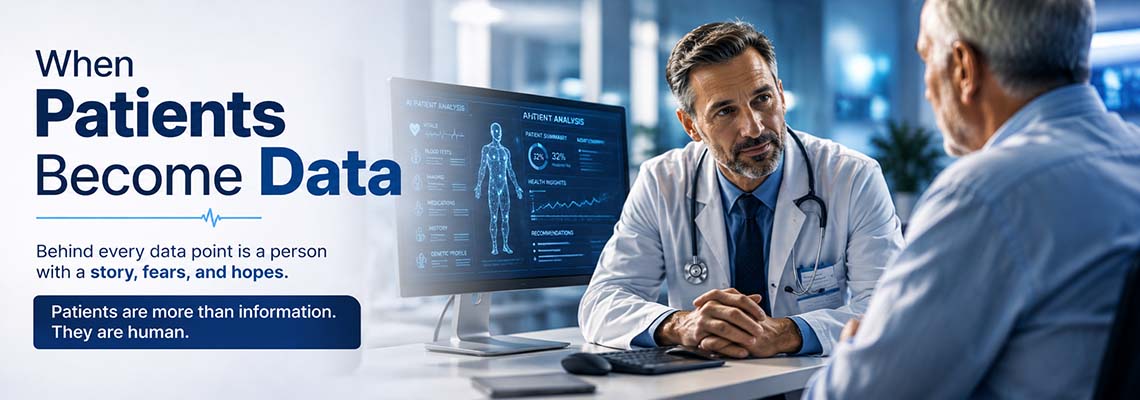
Modern medicine is learning to see the human body in extraordinary detail. Artificial intelligence can gather information from scans, blood tests, genetic profiles, wearable devices, sleep patterns, heart rhythms, medical histories, and even speech changes. In the future, a patient may arrive at a hospital only after their data has already arrived before them.
The system may know their risks, probabilities, habits, weaknesses, and likely disease pathways. It may know what illness they are moving toward before they feel sick. It may know which treatment is most likely to work before the doctor enters the room.
This is powerful. It may save millions of lives.
But it also raises a deeply human concern: what happens when medicine begins to see the profile before it sees the person?
Data is useful. In fact, good medicine depends on good information. A doctor needs test results, histories, symptoms, scans, and evidence. Without data, medicine becomes guesswork. AI can help organize complex information and reveal patterns that even experienced physicians may miss.
The danger is not data itself. The danger is believing that data is enough.
A patient is not only a collection of numbers. A patient is not merely a diagnosis, a risk score, or a predicted outcome. Behind every medical chart is a human life filled with memories, fears, responsibilities, relationships, regrets, hopes, and private struggles.
Two patients may have the same disease but suffer in completely different ways. One may fear pain. Another may fear becoming dependent. Another may fear leaving behind a spouse, a child, or unfinished words. The diagnosis may be identical, but the meaning of the illness is never identical.
This is where medicine must be careful.
A system may identify a patient as “high risk” or “low benefit.” It may recommend one treatment over another based on age, probability, cost, or projected survival. These recommendations may be mathematically reasonable. But human life often contains moral details that cannot be calculated so easily.
A patient may not be seeking treatment only to extend life. He may be seeking time to care for someone he loves. A woman may not fear her illness as much as she fears being reduced to it. An elderly patient may not want another procedure, but may desperately want to be heard before making that decision.
The screen tells what is measurable. The patient tells what matters.
As AI becomes more advanced, physicians will need to protect the human story within medical care. They must use data without allowing data to replace listening. They must welcome prediction without allowing prediction to imprison identity. They must remember that the person in front of them is always larger than the profile on the screen.
This will not be easy. Healthcare systems often reward speed, accuracy, and efficiency. Stories take time. Meaning takes attention. Human complexity does not always fit neatly into digital categories.
But without that complexity, medicine becomes emotionally thin.
Patients do not want to be treated as machines with biological errors. They want to be recognized as whole human beings experiencing illness. They want doctors who can read the chart, but also look beyond it. They want care that understands the body without forgetting the soul.
The future of medicine will depend on balance. AI can help physicians know more, see earlier, and act faster. But only human presence can remind medicine why that knowledge matters.
Because a patient is not a dataset waiting to be optimized. A patient is a life asking to be understood.