
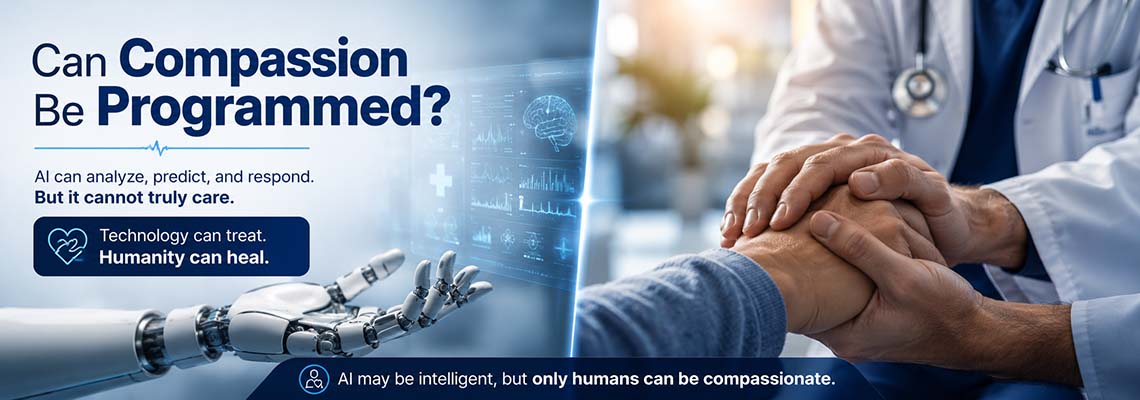
One of the most fascinating questions in the future of medicine is also one of the most difficult: can compassion be programmed?
Artificial intelligence is already becoming more emotionally responsive. Future systems may recognize sadness in a patient’s voice, detect anxiety through facial expressions, identify distress through body language, and respond with carefully chosen words of comfort. They may speak gently, pause at the right moment, adjust tone, and provide reassurance at any hour of the day.
To many people, this may sound wonderful. A frightened patient would never be left without a response. An elderly person living alone could receive constant emotional support. A child undergoing treatment could be comforted by a friendly digital companion. In a world where doctors and nurses are overworked, AI could help reduce loneliness and fear.
And in some ways, it truly could.
But the deeper question remains: is simulated compassion the same as real compassion?
A machine can recognize tears, but does it feel sorrow? It can say, “I understand,” but does it actually understand? It can offer comforting words, but does it care whether the patient suffers?
Some may argue that the difference does not matter. If a patient feels comforted, perhaps the source of comfort is less important. If AI reduces distress, then it has done something valuable. This argument cannot be dismissed easily. Relief matters. Comfort matters. Any tool that reduces suffering deserves attention.
Yet human compassion is more than a response. It is a relationship.
When a physician comforts a patient, the words carry the weight of shared humanity. A human doctor knows fear, grief, uncertainty, and mortality not as data, but as lived realities. A nurse who holds a patient’s hand during pain is not simply performing a programmed gesture. She is present as another human being who understands vulnerability.
That presence changes everything.
Bad news is a perfect example. An AI system may explain a diagnosis with flawless clarity. It may use sensitive language, pause at appropriate moments, and offer support resources. Technically, it may do everything correctly. But bad news is not only information. It is an event inside a human life. It changes the future in an instant. It reshapes family, memory, faith, and fear.
In that moment, patients often need more than correct words. They need someone to carry the truth with them.
This is what machines cannot fully do. They can communicate. They can respond. They can simulate warmth. But they cannot be morally wounded by suffering. They cannot regret a loss. They cannot stay awake at night remembering a patient they could not save. They cannot feel the heavy silence in a room after hope has changed shape.
And yet, the future should not reject emotional AI completely. Used wisely, it may support patients in meaningful ways. It may help identify distress earlier. It may offer companionship when human help is unavailable. It may assist healthcare workers by alerting them when a patient needs deeper emotional care.
But programmed compassion should never become a substitute for human compassion.
The goal should not be to replace the doctor’s heart with a machine’s voice. The goal should be to use technology in ways that protect and strengthen human care. AI can help medicine become more available, more accurate, and more responsive. But human beings must remain responsible for the moral center of healing.
Because compassion is not only about saying the right thing.
It is about being present for the right reason.
And in the age of artificial intelligence, that may become one of the last and greatest responsibilities of the human physician.