
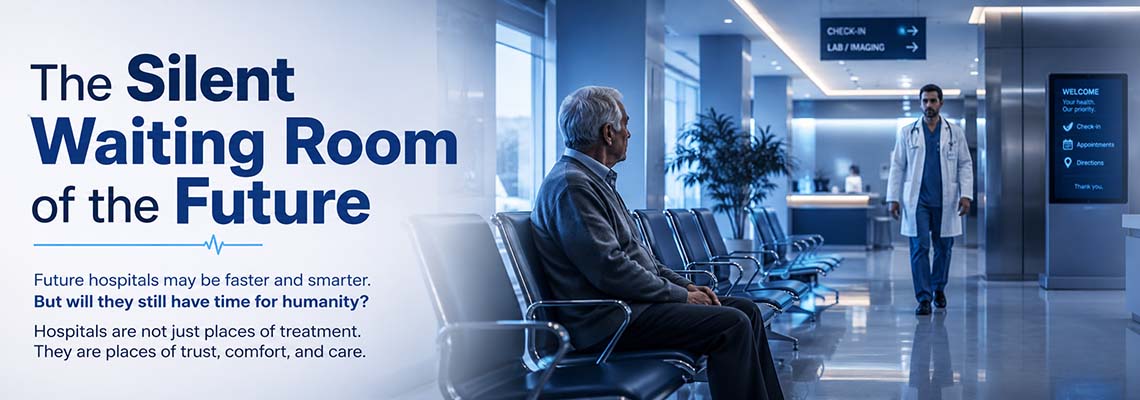
Imagine walking into a hospital where everything works perfectly.
There are no long queues. No misplaced files. No exhausted receptionist calling out names. No overcrowded waiting room filled with anxious families. Every patient is identified instantly. Every symptom is analyzed within seconds. Every scan, blood test, genetic marker, and previous medical record is already available before the patient even sits down.
At first, it sounds like the hospital of our dreams.
But now imagine something else: the waiting room is silent.
Not peaceful. Not calm. Silent in a way that feels strangely empty.
This is one of the most haunting possibilities of future medicine. As hospitals become more intelligent, efficient, and automated, they may also become less emotionally alive. The chaos of old hospitals may disappear, but so may the human warmth that once filled them.
Artificial intelligence can reduce errors, improve diagnosis, shorten waiting times, and manage patient care with remarkable precision. It can detect disease before symptoms appear. It can monitor vital signs every second. It can alert staff before a crisis develops. From a scientific point of view, this is extraordinary progress.
But a hospital is not only a place where bodies are repaired. It is a place where human beings experience some of the most vulnerable moments of their lives.
People wait for biopsy results. Parents sit beside sick children. Elderly patients face the possibility of losing independence. Families whisper prayers in corridors. Patients ask questions they are afraid to ask out loud. In such moments, the hospital is not merely a technical environment. It is an emotional world.
If that world becomes too automated, something important may be lost.
A machine can tell a patient that the treatment plan is optimized. It can explain survival percentages and medication schedules. It can speak in a gentle voice and display comforting words on a screen. But the patient may still feel alone, because reassurance is not only about information. It is about presence.
A human doctor or nurse carries something a machine cannot fully imitate: shared vulnerability. A human caregiver knows fear, exhaustion, grief, and hope from inside the human experience. That knowledge gives comfort a different weight. The words “I am here with you” mean something deeper when spoken by someone who understands what it means to suffer.
The future hospital may cure more diseases than ever before. It may become cleaner, faster, safer, and smarter. But if patients feel unseen while being treated, then medicine will have solved one problem while creating another.
Loneliness inside healthcare is not a small matter. A patient can be surrounded by monitors, sensors, and intelligent systems, yet still feel emotionally abandoned. Their oxygen levels may be stable, their medication perfectly adjusted, and their recovery medically successful—but their heart may still ache for a human face.
This is why the future of medicine must include more than technological design. It must include emotional design. Hospitals must ask not only, “How can we treat faster?” but also, “How can we make patients feel accompanied?” Not only, “How can we reduce error?” but also, “How can we preserve trust?”
The silent waiting room should not be our final vision of progress.
The best hospital of the future will not be the one with the fewest humans. It will be the one where technology works so well in the background that doctors, nurses, and caregivers have more time to do what machines cannot: listen, comfort, witness, and remain present.
Because sometimes healing begins before treatment starts.
Sometimes it begins when someone sits beside you and makes the room feel less silent.