
Medicine has always been more than the study of disease. At its deepest level, medicine is the meeting point between science and suffering. A patient enters a clinic not only with symptoms, but with fear, confusion, hope, and the silent question: Will someone understand what I am going through?
Today, artificial intelligence is changing healthcare at a speed earlier generations could hardly imagine. Machines can analyze scans, detect patterns, predict disease risks, and assist doctors in making decisions with extraordinary accuracy. In many ways, this is a medical miracle. A tumor may be recognized earlier. A heart attack may be predicted before it happens. A treatment plan may be designed according to a person’s genetic profile. Lives will be saved because machines can process information faster than any human mind.
Yet the real question is not whether AI will make medicine more powerful. It will. The real question is whether medicine can remain human while becoming increasingly artificial.
A machine may diagnose illness, but can it recognize the fear hidden behind silence? Can it understand the trembling voice of a patient who says, “I am fine,” while clearly not being fine? Can it sit beside someone after bad news and know that, sometimes, no answer is needed immediately?
The history of medicine has always included tools. From the stethoscope to the X-ray, from antibiotics to robotic surgery, technology has helped physicians see more clearly and treat more effectively. But until now, these tools remained in the hands of human healers. Artificial intelligence is different because it does not merely assist medicine; it may begin to direct it.
That is both exciting and unsettling.
The danger is not that machines will become intelligent. The danger is that healthcare systems may begin to value intelligence more than wisdom, speed more than listening, and efficiency more than presence. In such a world, patients may receive perfect treatment plans while still feeling emotionally abandoned.
Healing is not only the removal of disease. It is also the restoration of reassurance, dignity, and meaning. A patient with cancer does not only want statistics. A dying patient does not only want a survival estimate. A frightened family does not only want clinical accuracy. They want someone who can carry the emotional weight of the moment with them.
This is where the human physician remains irreplaceable.
The physician is not valuable only because of knowledge. The physician is valuable because of judgment, conscience, memory, tenderness, and the ability to witness suffering as one human being standing beside another. A doctor’s hand on a shoulder, a pause before difficult news, a calm voice in a moment of panic—these are not small details. They are part of medicine’s soul.
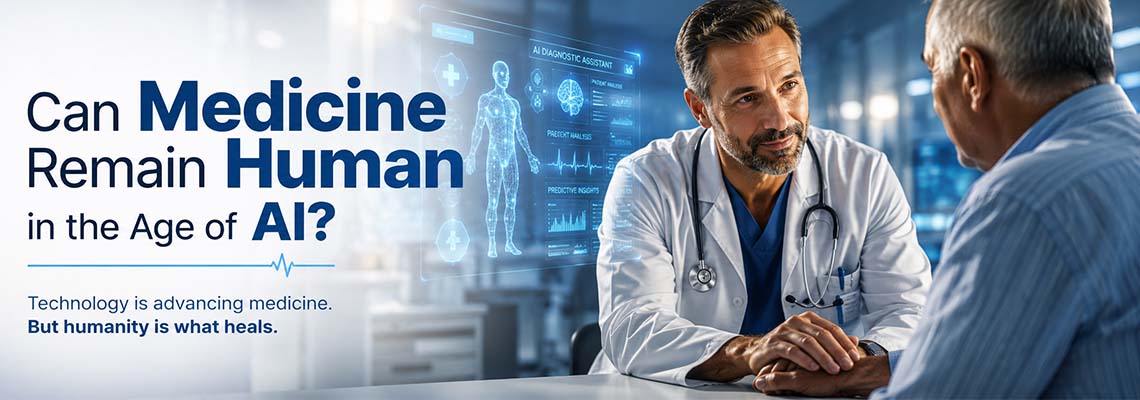
The future of healthcare should not be a battle between humans and machines. It should be a partnership. AI should help physicians become better healers, not replace healing with automation. The best future is not one where technology removes the human doctor, but one where technology gives doctors more time to be human again.
Because medicine may continue evolving, but healing must remain human.
And perhaps the greatest challenge ahead will not be teaching machines how to think. It will be reminding humanity not to forget how to feel.